








Introduction
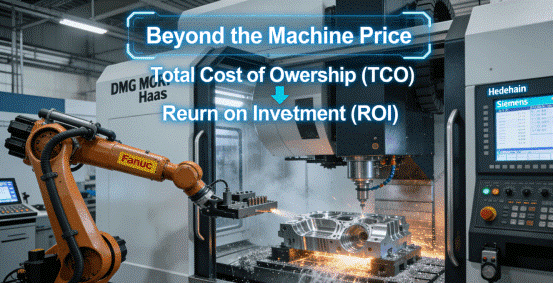
When manufacturing complex parts, traditional 3-axis methods often lead to high costs and inefficiency. A narrow focus on the CNC 5 axis price overlooks the full Total Cost of Ownership (TCO) for 5 axis CNC machining services, including hidden process and scrap costs. This analysis deconstructs the true cost model, demonstrates the value of Automated 5-Axis Machining via automated machining solutions, and provides a practical ROI evaluation framework.
Besides the machine price, what are the often-overlooked hidden costs of 5-axis CNC machining?
When evaluating 5 axis CNC machining services, fixating on the machine purchase price is a critical oversight. The initial cost of a 5 axis CNC machine represents only the tip of the financial iceberg. Beneath the surface, a suite of hidden costs significantly impacts the project’s final economics.First are the design and manufacturing costs for complex workholding and fixtures. While the goal of multi axis CNC is to reduce setups, specialized, high-precision, multi-degree-of-freedom fixtures are often essential for securing intricate or thin-walled parts, representing a substantial one-time engineering investment. Second, advanced CAM programming and simulation costs rise considerably. 5-axis toolpath planning is far more complex than 3-axis, requiring engineers with higher skill levels and expensive proprietary software. Offline simulation to prevent costly machine collisions becomes mandatory, adding to both labor and software licensing expenses.
Furthermore, specialized tooling inventory and wear for multi axis CNC processes add up. To leverage the full angular flexibility of 5-axis machining, non-standard short holders, ball-nose, or taper tools are frequently needed. These tools carry a higher procurement cost and may wear faster due to complex cutting conditions. Finally, achieving promised precision necessitates a high-standard quality control regime. This requires investment in advanced metrology equipment like laser trackers or CMMs with rotary tables to verify complex freeform surfaces, representing another significant capital and training expenditure. A comprehensive assessment of these costs is, therefore, a prerequisite for selecting truly reliable Precision Manufacturing Solutions.
How to calculate the true Return on Investment (ROI) for an automated 5-axis machining center?
Investing in an Automated 5-Axis Machining cell derives its value from optimizing the entire production flow. Calculating its true Return on Investment (ROI) requires establishing a framework that encompasses total lifecycle costs and benefits.
A Framework for Quantifying Costs and Benefits
A simplified ROI calculation centers on comparing the total investment against annualized gains. The total investment includes not only the 5 axis CNC machine, robotics, and automated pallet systems but also system integration, personnel training, and necessary facility upgrades. The output benefits, however, are more diverse and directly quantifiable.
Key Drivers of ROI
- Direct Gains in Efficiency and Quality
The automated cell enables 24/7 lights-out or reduced-manning operation, drastically cutting machine idle time. Completing multiple part features in a single setup eliminates the positional errors inherent in traditional multi-operation workflows, thereby significantly reducing scrap rates. A study in the International Journal of Advanced Manufacturing Technology notes that integrated automation systems, by optimizing process flow and reducing human intervention, can lower overall production costs by 15-30% in complex scenarios like hybrid additive subtractive manufacturing.
- A Fundamental Shift in Operations
Automation frees operators from repetitive loading/unloading tasks, allowing them to focus on higher-value activities like programming optimization, quality monitoring, or equipment maintenance. Simultaneously, production predictability improves, overall lead times shorten, and responsiveness to customer demands increases, enhancing market competitiveness.
Making an Informed Investment Decision
In summary, ROI analysis should dynamically combine equipment depreciation, maintenance costs, and the aforementioned benefits. For readers seeking a deeper dive into system integration, a detailed guide on Automated 5-Axis Machining offers further insights.
How does automated 5-axis simultaneous machining improve the final part’s cost-performance ratio compared to traditional multi-step processing?
The core value of Automated 5-Axis Machining lies in how it redefines “cost-performance” through technological integration. Compared to traditional multi-step processing, its advantages extend far beyond “faster” to “better and more reliable,” establishing a decisive advantage in total cost.In complex CNC Machining Applications, such as aerospace engine impellers or medical bone implants, part geometries are extremely intricate. Traditional methods require multiple setups on 3-axis or 5-axis machines, with each setup introducing minute errors that accumulate, ultimately compromising overall part accuracy and fit, leading to high inspection and rework costs. Automated 5-axis simultaneous machining can finish complex curves, pockets, and undercuts on all five sides (except the base) in a single clamping. This fundamentally eliminates error stacking between operations, ensuring exceptional geometric tolerances and surface consistency.
This “one setup, one good part” capability directly translates to a superior cost-performance ratio. It reduces part handling, waiting, and secondary setup time between machines, shortening the total manufacturing cycle. More importantly, by improving first-pass success rates and batch consistency, it drastically lowers the risk of scrap due to inaccuracy and subsequent assembly issues. Therefore, for complex components, investing in Automated 5-Axis Machining is not just purchasing equipment; it is purchasing the certainty of “getting it right the first time” and a reduction in total cost.
In aerospace and medical fields, how do strict certifications impact machining costs and supplier selection?
In high-end CNC Machining Applications like aerospace and medical, the cost of a part extends far beyond material and machine time. The compliance costs associated with rigorous adherence to Quality Control Standards are an integral part of evaluating Precision Manufacturing Solutions and directly influence supplier selection.
Standards such as AS9100D (aerospace) and ISO 13485 (medical devices) are far more than certificates. They represent a complete quality management system requiring full traceability and verification across the entire process—from raw material sourcing and production control to equipment calibration, personnel qualification, and final inspection. This mandates that suppliers make ongoing investments in documentation, process records, regular audits, and dedicated inspection equipment. These investments undoubtedly increase the per-part cost, but they are a necessary investment to ensure part safety, reliability, and biocompatibility in extreme environments.
From a client’s perspective, choosing a supplier without relevant certifications may offer a lower quote in the short term but carries immense hidden risk. A minor, unvalidated process deviation could lead to in-service part failure, triggering catastrophic incidents or massive product recalls with losses far exceeding manufacturing costs. Therefore, paying a reasonable compliance cost is essentially purchasing risk mitigation. Selecting a partner with authoritative certifications means choosing their proven, stable manufacturing and quality management system, which is a long-term strategy for ensuring supply chain resilience and product success.
How should enterprises evaluate and select a reliable 5-axis CNC machining service partner?
Choosing the right 5 axis CNC machining services provider is a strategic decision. Enterprises should look beyond simple price comparisons and conduct a comprehensive evaluation across technology, quality, systems, and service.
H3: In-Depth Evaluation of Technology and Case Studies
First, the provider’s multi axis CNC technical capability should be thoroughly examined. Request case studies for parts with complexity similar to your own, ideally with an on-site visit to observe machine brands, condition, automation integration, and overall workshop management. A professional service provider typically offers a full range of services from rapid prototyping to volume production, as detailed in this overview of comprehensive 5 axis CNC machining services.
Scrutinizing Quality Systems and Compliance Certifications
The quality management system forms the cornerstone of a supplier’s reliability. It is imperative for manufacturers to verify that a potential partner holds relevant international certifications, which serve as independent endorsements of their standardized process control and commitment to consistency. These certifications are not merely plaques on the wall but represent a deeply integrated operational discipline.
- Foundational and Industry-Specific Certifications
A robust foundation often begins with ISO 9001, which outlines the principles for a basic quality management system. For partners serving regulated industries, specific certifications are non-negotiable. IATF 16949 is essential for automotive work, while AS9100D is the stringent standard for aviation, space, and defense. These frameworks mandate rigorous controls over every aspect of production, from design and sourcing to manufacturing and inspection.
- Certification as a Proxy for Capability and Risk Mitigation
Holding these certifications signals a provider’s capability to deliver stable, repeatable output. For instance, a manufacturer like JS Precision, certified to AS9100D and IATF 16949, demonstrates a comprehensive system for risk management, traceability, and continuous improvement. This directly translates to lower supply chain risk for the client, as certified processes are designed to prevent defects and ensure compliance, ultimately protecting the client from costly recalls or failures.
Evaluating Engineering Support and Continuous Improvement
Beyond quality systems, a truly valuable partner contributes intellectual capital through proactive engineering support. An excellent supplier possesses strong Design for Manufacturability (DFM) capabilities, allowing their engineers to collaborate during the design phase to optimize parts for efficiency, cost, and performance. This early collaboration can dramatically reduce production challenges and total cost. Furthermore, a commitment to continuous improvement is vital. Prospective clients can assess this by inquiring about a supplier’s adoption of lean principles, investment in new technology, and use of data analytics. Frameworks from authoritative bodies like the U.S. National Institute of Standards and Technology (NIST) on advanced manufacturing maturity can provide a reference for evaluating a supplier’s forward-looking commitment to technological iteration and operational excellence.
Conclusion
In summary, the decision to invest in automated 5-axis CNC machining technology should be based on a deep understanding of its full lifecycle cost and value, not merely the initial quote. Through transparent cost analysis, quantification of automation benefits, and stringent evaluation of a supply partner’s quality system, manufacturers can significantly optimize the production cost and performance of complex components while effectively managing project risk.
If you are seeking economically efficient and reliable Precision Manufacturing Solutions for complex CNC Machining Applications, consult a professional 5-axis machining service provider today to obtain a personalized cost-benefit analysis and solution based on your part geometry and material.
H2:Author Bio
The author, a senior manufacturing analyst, specializes in advanced manufacturing technologies, production operation optimization, and supply chain cost research. With over a decade of experience, they provide manufacturing strategy consulting for the industrial equipment, aerospace, and automotive sectors.
H2:FAQs
Q1: Is 5-axis CNC machining always more expensive than 3-axis?
A1: For simple parts, yes. However, for complex geometries, 5-axis often results in a lower total cost through reduced setups, fixtures, and inspection time, with higher quality. Evaluation should be based on total manufacturing cost, not a single operation rate.
Q2: How is the ultra-high precision of 5-axis machined parts ensured?
A2: It relies on high-end machine tools with thermal compensation, validated machining strategies, on-machine probing, and final CMM inspection. Strict adherence to Quality Control Standards from programming to inspection is key.
Q3: What special materials can 5-axis machining handle?
A3: It can process a wide range of materials from aluminum and stainless steel to high-temperature alloys (like Inconel) and composites. Automated 5-Axis Machining is particularly suitable for difficult-to-machine materials as it optimizes tool angles and cutting forces.
Q4: What is the typical lead time from design to receiving a prototype?
A4: Lead time depends on part complexity. Professional 5 axis CNC machining services providers can typically deliver moderately complex metal prototypes within 1-2 weeks. Automated production lines can further compress lead times for volume production.
Q5: How important are supplier certifications like ISO or AS9100D to me?
A5: Critically important. These certifications are independent verification of a supplier’s quality management system, process control capability, and commitment to continuous improvement. They are directly related to part consistency, traceability, and the final product’s safety and reliability, especially in regulated industries.